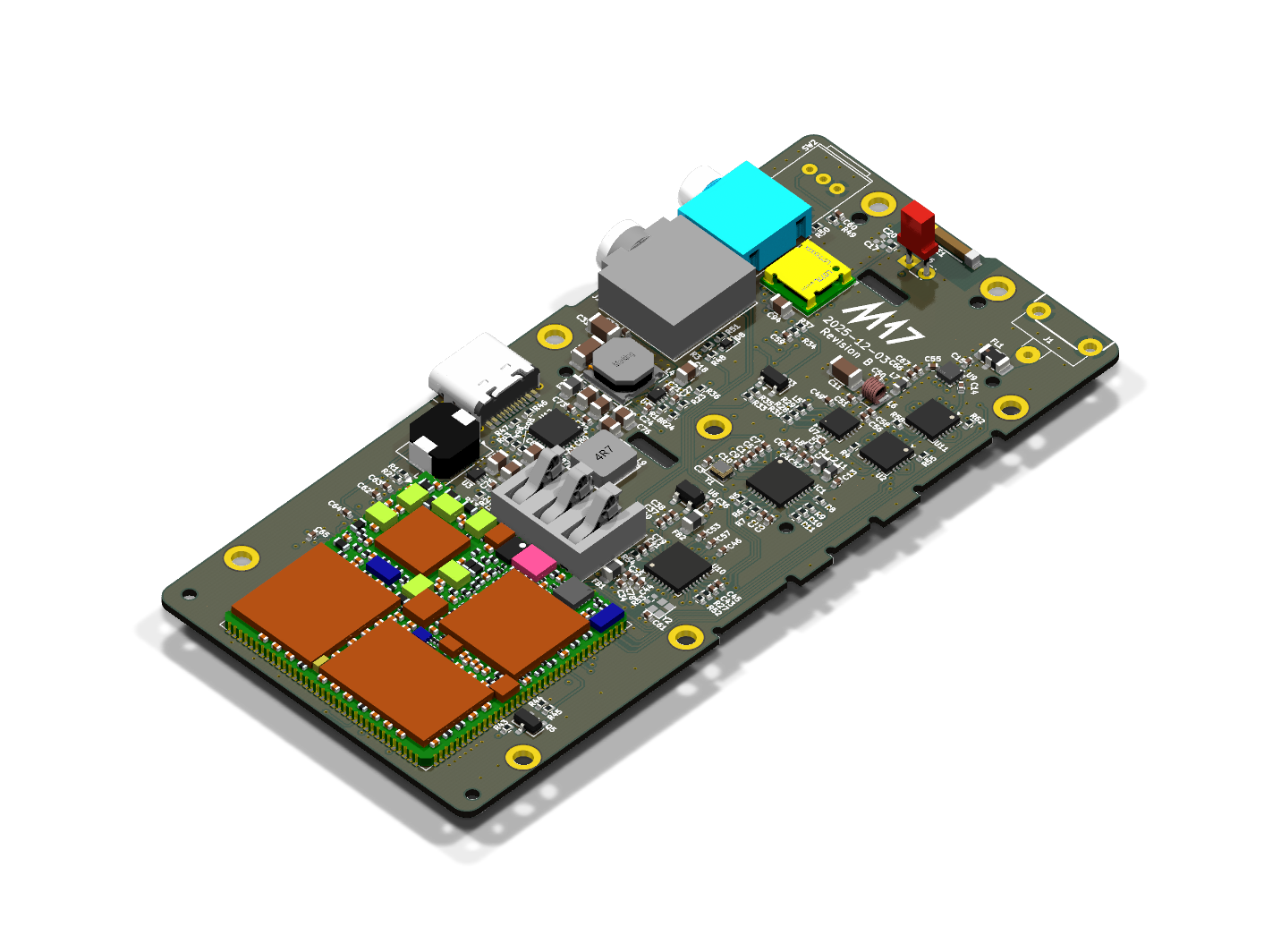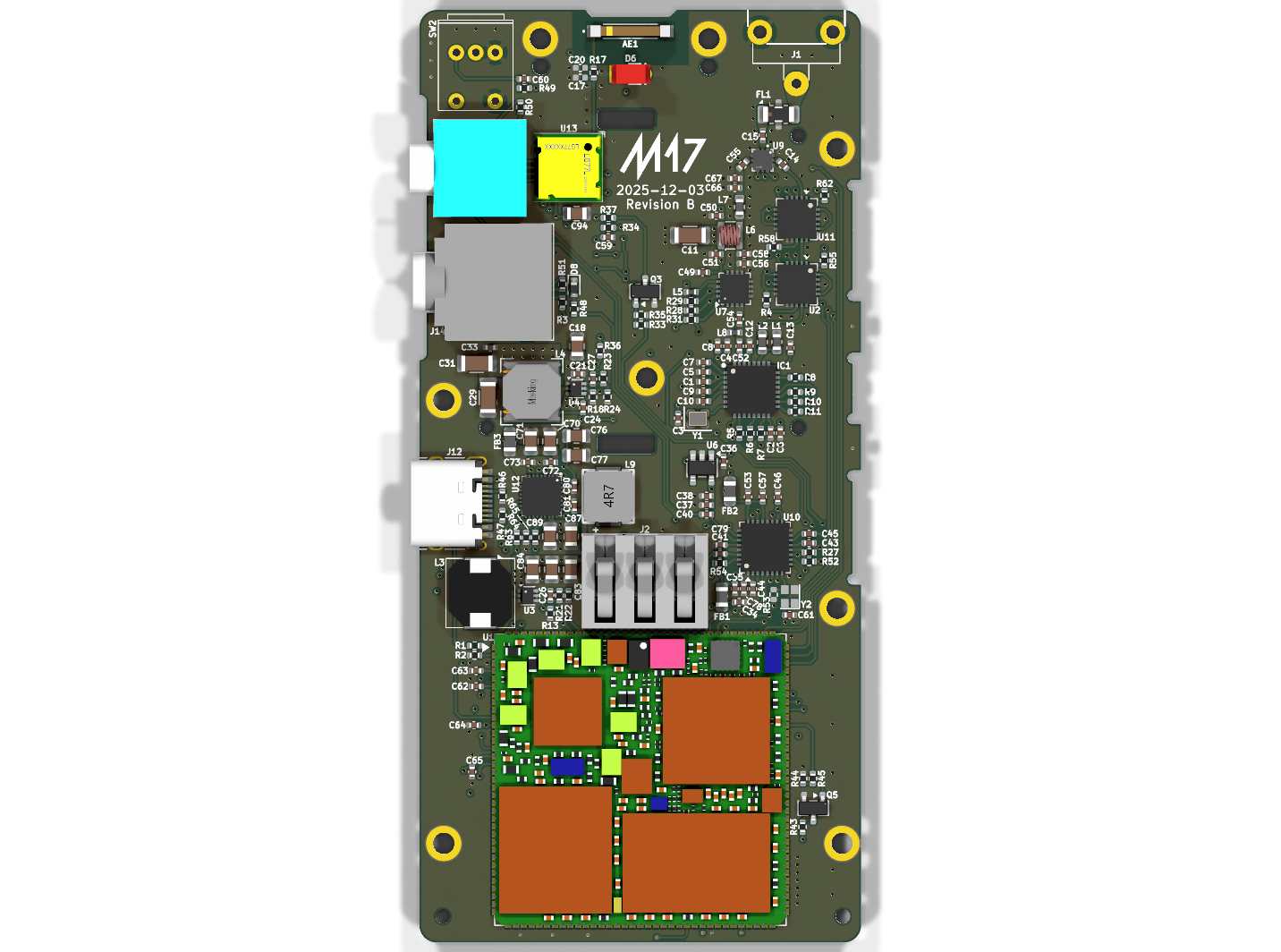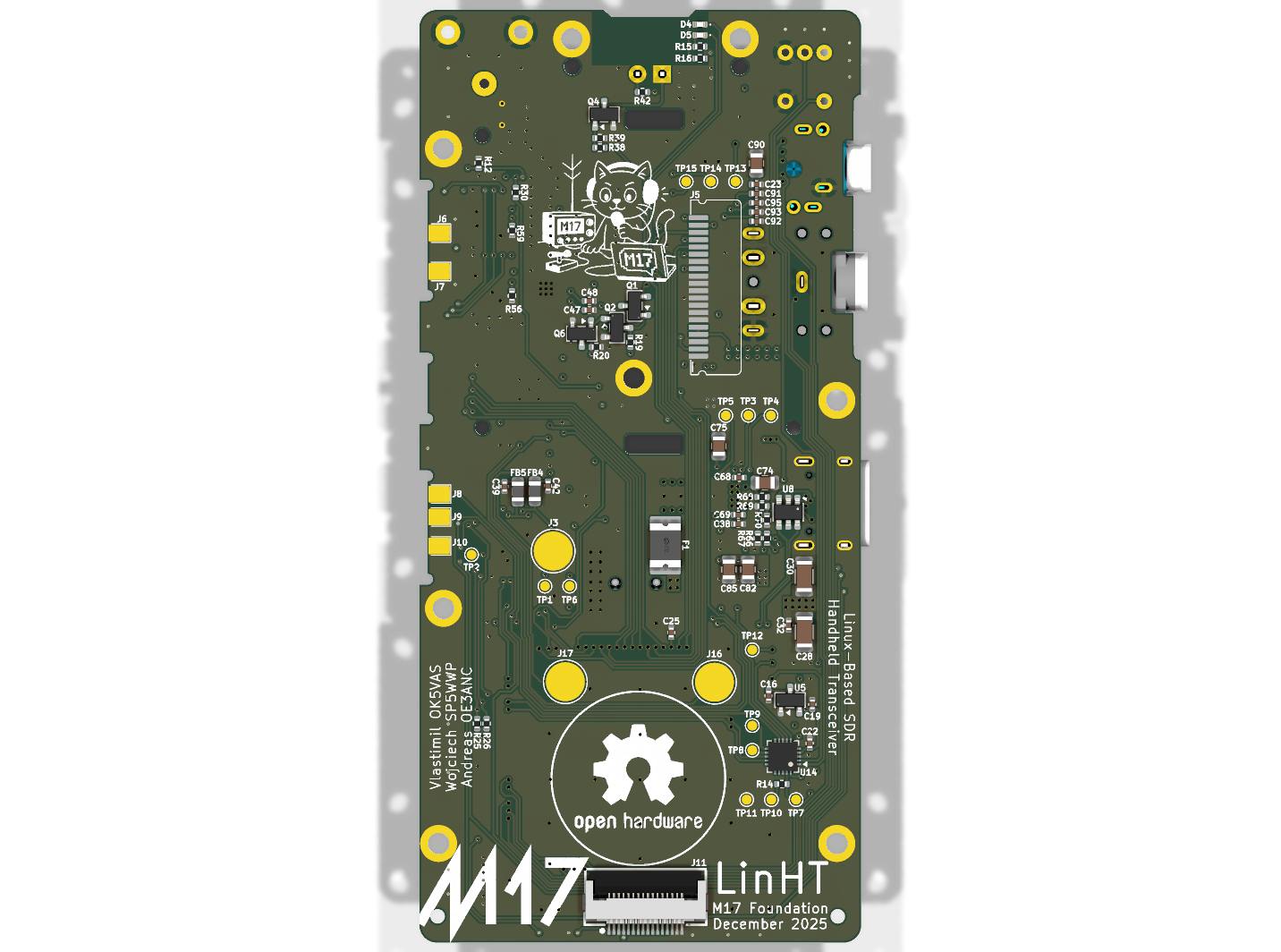
LinHT Hardware Documentation
Hardware documentation and design files for the LinHT main board.
Hardware documentation and design files for the LinHT main board.
Open-source, Linux-based, SDR handheld transceiver



LinHT is an open-source handheld software-defined radio (SDR) transceiver built around a modern Linux System-on-Module and a true IQ RF front-end.
It is the successor of the OpenHT project, with focus on:
LinHT is developed by members of the M17 community and is intended primarily for radio amateurs, SDR experimenters, and developers.
This repository contains the hardware design files for LinHT.
📅 October 2026 status
A test batch of Rev C boards is being tested. Standby.
Rev C is the current development revision onmain. It has not yet been tagged, or validated.
Rev B was manufactured and tested; the results are summarized in the Rev B status report.⚠️ Important
LinHT is not a consumer product yet.
It is an experimental, community-driven open hardware project.
LinHT is built around a Linux SoM and a wideband IQ transceiver.
CPU
Memory
| Device | Role in LinHT | Main features |
|---|---|---|
MCM-iMX93-C1700D-D2-N32 |
Linux System-on-Module | Dual Cortex-A55, Cortex-M33, 2 GB LPDDR4, 32 GB eMMC |
SX1255IWLTRT |
Direct-IQ RF front-end | Programmable UHF RX/TX signal chain with separate I/Q baseband paths |
GRF5604 |
RF power amplifier | 100–600 MHz, 6 W class; about 4.5 W CW measured on Rev B |
2× PE4312C-Z |
Receive-path attenuation | 6-bit digital step attenuator, 0.5 dB steps, 31.5 dB range per device |
SKY13330-397LF |
RF TX/RX switching | SPDT RF switch covering 0.1–6.0 GHz |
TLV320AIC3100IRHBR |
Audio codec | Low-power codec with audio processing and mono Class-D speaker amplifier |
LG77LICMD |
GNSS receiver | Single-band, multi-constellation GPS, GLONASS, Galileo, BDS, and QZSS |
BQ25792RQMR |
USB-C battery charger and power path | Buck-boost charger for the 2S battery, I2C control and telemetry |
ATtiny826-MU |
Always-on power-management controller | Rail sequencing, button handling, boot-mode control, and shutdown coordination |
TPS565242DRLR |
Main 5 V supply | 5 A synchronous step-down converter |
The values below describe the tested Rev B hardware and the current Rev C design. Rev C retains the same main RF chain but must be measured again after manufacturing.
| Parameter | Value |
|---|---|
| Frequency range | UHF band (exact limits depend on PA/filter configuration) |
| Bandwidth | up to 500 kHz IQ |
| Architecture | Direct IQ (complex baseband) |
| TX power | about 4.5 W CW measured on Rev B; around 3.5 W during an M17 test |
| RX features | Two programmable step attenuators and gain control |
| Modes | FM, SSB, M17, experimental digital modes |
📌 UHF only!
VHF is not supported by the current hardware revisions. The current priority is stability, manufacturability, and software maturity.
LinHT runs a custom Yocto-based Linux distribution designed for SDR and embedded radio use.
Standard Linux tools (gcc, gdb, strace, etc.) are available directly on the device.
This list reflects software and hardware work demonstrated with Rev A and Rev B. Rev C hardware has not yet been tested.
LinHT is developed iteratively. Each revision serves a specific purpose.
| Revision | Status | Purpose |
|---|---|---|
| Rev. A | Completed | Architecture proof of concept |
| Rev. B | Completed | Integrated feature prototype and system testing |
| Rev. C | In development (main), being tested |
Targeted corrections based on Rev B testing |
See the project changelog for the changes introduced by each hardware revision.
This repository contains:
Gerbers, BOM, pick-and-place files, and schematics are:
Generated outputs follow the current main branch and therefore currently
represent the unvalidated Rev C design. Use the revA and revB Git tags for
historical revision snapshots.
LinHT is designed as a replacement mainboard for the Retevis C62 handheld radio. You will need:
More details (Rev. A focused, older but useful): LinHT Open SDR Handheld For Radio Amateurs
Prebuilt Linux images for LinHT are available here: https://m17project.org/linht/
Documentation:
Yocto layers:
Flashing is done using NXP Universal Update Utility (uuu).
The intended Rev C workflow is to hold the secondary side button while powering on. The ATtiny then requests USB boot from the SoM through the corrected level-domain interface. This Rev C workflow has not yet been validated on manufactured hardware.
Rev B cannot use the side-button USB-boot function reliably. Its ATtiny firmware
disables that behavior; development boards are flashed by interrupting U-Boot
over the Kenwood connector and running ums 0 mmc 0, or by manually driving the
SoM USB_BOOT input. See the
Rev B status report
for the hardware background.
Once the board is in USB boot mode, flash it using:
uuu -v -b emmc_all imx-boot-mcm-imx93-sd.bin-flash_singleboot linht-image-mcm-imx93.rootfs.wic.zst
Tool download: mfgtools
To access LinHT’s USB network device on Windows, install the RNDIS driver: microsoft.com USB RNDIS Gadget
Primary documentation lives on the M17 Wiki:
LinHT is a community project and contributions are welcome. The best way to get involved is joining the M17 Discord, look for channel: #linht.
This is the preferred place to:
Other ways to contribute:
If you’re an experienced embedded Linux or SDR developer, we would love your help.
You currently cannot buy LinHT as a product. To build LinHT, you need to:
This may change in the future.
Not yet. And maybe never in the "consumer radio" sense. LinHT is currently best suited for:
You should not expect:
No. The current LinHT hardware revisions are UHF-only.
VHF support is a frequently requested feature, but it is not currently planned. Adding another band significantly increases:
Right now, the project is focused on:
VHF is not ruled out for future revisions, but it is not a current priority.
LinHT itself is not certified. Responsibility lies with the builder and the operator. LinHT is intended primarily for:
Always follow your local radio regulations.
The best starting point is discussion. Join the M17 Discord, channel: #linht.
Good ways to contribute:
If you’re unsure where to help - just ask.
This project is licensed under: Creative Commons Attribution-NonCommercial-ShareAlike 4.0 International
You are free to:
Under the conditions:

LinHT is developed by the M17 community, with contributions from many individuals. Thanks to everyone testing prototypes, reviewing schematics, writing software, and sharing ideas.